



LSU Research Insights: Solar Innovations Aim to Strengthen Global Supply Chains and Cut Pollution
January 06, 2026
In 2026, the world’s energy demand will reach an unprecedented level. Cost-effective and environmentally friendly energy sources are critical.
In this Q&A, we chat with Charlotte Jacobs, an assistant professor in the E. J. Ourso College of Business Rucks Department of Management, whose research focuses on the photovoltaic cell industry.
2026 & BeyonD
As we enter a new year of research and discoveries, our LSU experts are looking forward to the biggest challenges we will face and advances we can anticipate. What might our future look like, “soonish”? How can we help to shape the future we want to see?
A photovoltaic (PV) cell, also known as a solar cell, is an electronic device that converts sunlight's energy into electricity. Jacobs is interested in the emergence and evolution of this industry and how knowledge is being created to improve photovoltaic cells.
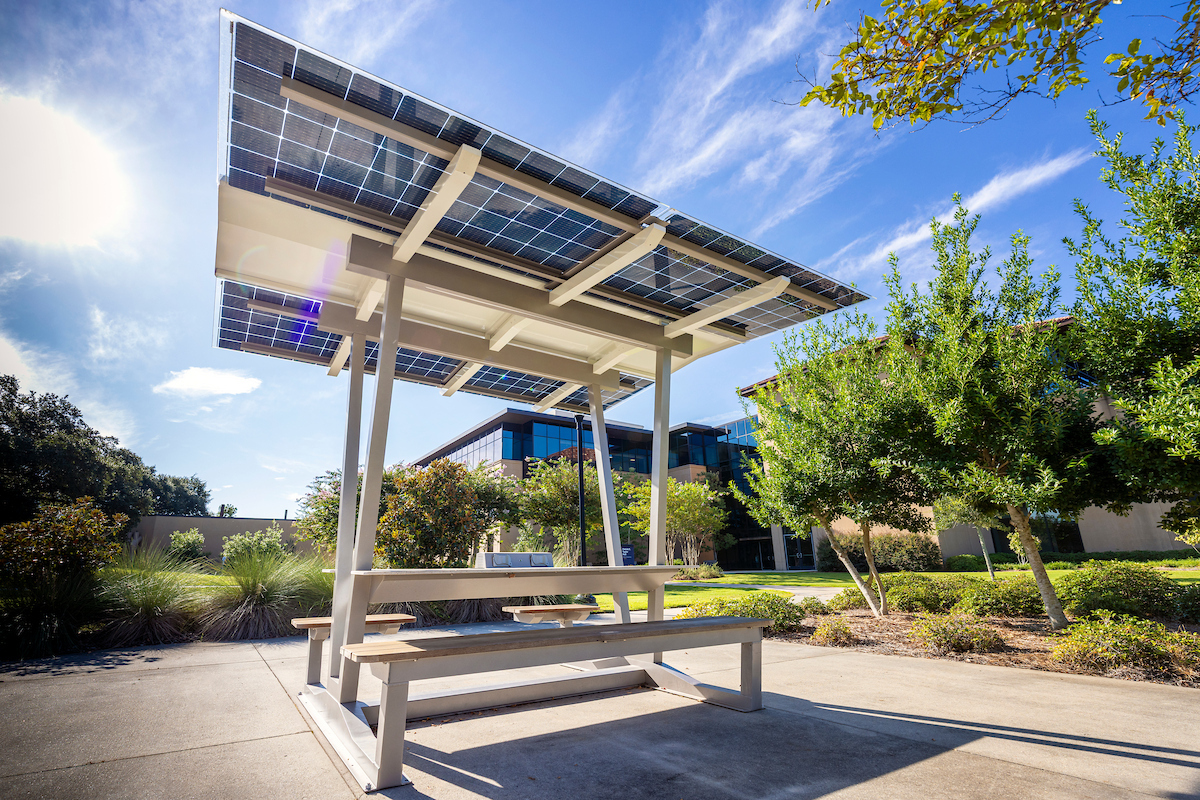
On-campus solar shelter at LSU.
“ Cleaner air is a universal good, and framing energy transitions around this shared interest could help build wider support for renewable technologies. ”

Charlotte Jacobs,
LSU assistant professor
What are we likely to see in 2026 in terms of progress, discoveries, emerging technology, or research directions in the PV cell industry?
In the coming years, the field is likely to undergo substantial transformation, driven primarily by an extraordinary rise in electricity demand. This demand stems not only from the rapid expansion of energy-expensive data centers supporting advances in AI and large-scale computing, but also from a broader societal shift toward electrification.
A central question for the next five years will be whether renewable and clean energy sources can keep pace with this surge in demand.
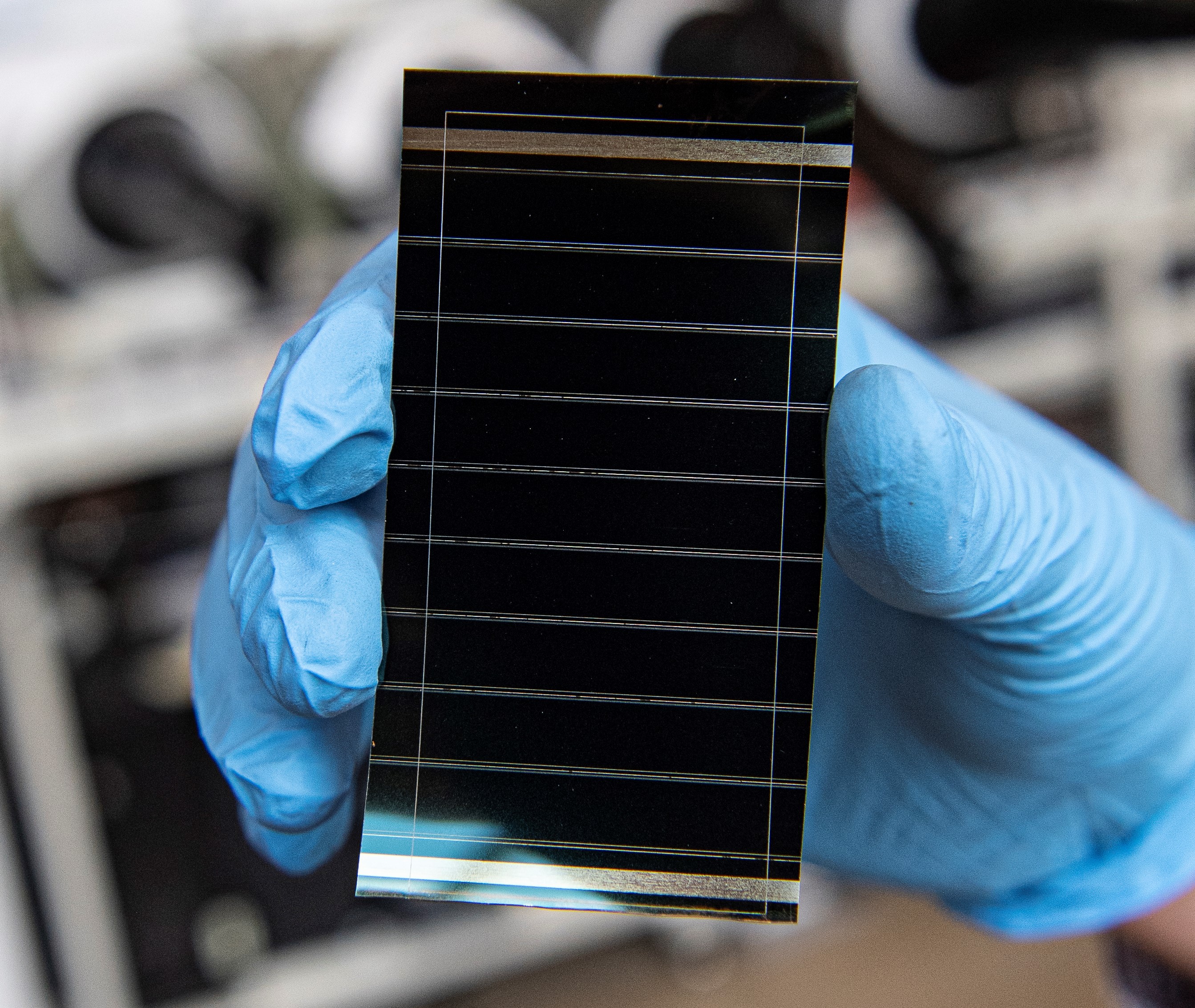
Perovskite-based photovoltaic (PV) solar cell.
Solar power has grown remarkably, yet global capacity remains heavily reliant on Chinese manufacturers, who currently dominate conventional photovoltaic panel production. Whether this supply structure is resilient enough to meet the rising demand remains uncertain, and geopolitical dynamics may further complicate the situation.
This creates a strategic opening for emerging solar technologies. In North America, Europe, and Japan, there is increasing investment in new technologies—most notably perovskite-based photovoltaics and other more adaptable solar materials.
These technologies offer fundamentally different value propositions compared to traditional rigid panels, including lighter weight, greater flexibility, and a much wider range of potential applications. Such features could allow solar energy to be integrated into surfaces and contexts that were previously infeasible.
Editor’s note: A perovskite solar cell is a type of thin-film solar cell that uses a light-absorbing material with a perovskite crystalline structure (like the calcium titanium oxide mineral called perovskite) instead of crystalline silicon. This type of solar cell can be more efficient and cheaper to produce, with a thin light-absorbing layer that can be sprayed onto a surface.
The field will likely witness a critical “make-or-break” period for these innovations. Their technical progress, scalability, and commercial viability will determine whether Western firms can regain a stronger position in the solar supply chain and contribute meaningfully to meeting accelerating energy needs.
If they succeed, we may see the beginning of a more diversified and resilient global solar industry by the end of the decade.
What are some challenges you foresee in the PV industry?
A key challenge will be the uncertainty surrounding emerging clean-energy technologies. These technologies already face long development timelines and significant scaling hurdles, and their progress is further complicated by unstable policies.
The on-again, off-again nature of tariffs, shifting priorities in government funding, and cuts to research grants for renewable energy projects create instability that discourages long-term investment.
This uncertainty affects not only firms but also universities and research labs, making it more difficult to hire talent, initiate new ventures, or maintain the credibility and continuity required to bring innovations to market.
The global context compounds these challenges. Heightened geopolitical tensions and stricter international policies are reducing the ease of cross-border collaboration and knowledge exchange, both of which are essential to technological advancement in energy and materials science.
As channels for sharing expertise narrow, the development of next-generation solar technologies and other clean-energy solutions may slow down at a moment when rapid progress is most needed.
Where would you LIKE to see this field go in the next 1-5 years? What are some questions or avenues for research you think should get more attention in 2026?
I would like to see the world move toward a broader, collective recognition of the value of cleaner air.
Even for those who remain skeptical about the long-term consequences of climate change, the immediate health and societal benefits of reducing pollution are difficult to dispute. Cleaner air is a universal good, and framing energy transitions around this shared interest could help build wider support for renewable technologies.
I also hope to see greater emphasis on national energy resilience. Reducing dependence on fossil fuels—both for environmental and geopolitical reasons—could help ease international tensions and create more stable, secure energy systems. Solar energy, with its scalability and widespread applicability, is especially well-positioned to contribute to this goal.
From a research perspective, the next few years would benefit from a deeper inquiry into how to fully unlock the potential of solar energy. This includes understanding how emerging photovoltaic technologies can be integrated into diverse environments, how supply chains can be made more secure and sustainable, and how policy frameworks can better align with long-term clean-energy objectives.
Strengthening interdisciplinary work across materials science, engineering, social science, and policy will be essential. Ultimately, I hope these efforts converge to enable solar energy to reach its full potential as a cornerstone of a cleaner future.
What are you most excited about in terms of research and discoveries in your field in 2026?
I am very excited not only about the potential of new photovoltaic technologies but also about integrating carbon capture as a solution to cleaner air. There is a lot happening there, and many projects on the horizon. We’ve seen nothing yet!
What do you wish more people knew about your area of research and its implications?
I wish more people understood the pivotal role that oil and gas companies played in the early development of the solar energy industry. Their involvement is unknown to many.
Historically, these firms were essential actors in establishing and growing the industry. Their investments supported foundational research, commercialization efforts, and early market development at a time when few other organizations had the resources or strategic interest to do so.
It is important to acknowledge that their engagement stemmed from concerns about energy independence and the potential depletion of fossil fuel resources. Even so, these investments helped create the technological and industrial base that today’s solar sector relies upon.
Next Steps
Let LSU put you on a path to success! With 330+ undergraduate programs, 70 master's programs, and over 50 doctoral programs, we have a degree for you.